The Legend of Zelda (sometimes called "Zelda 1" or "Original Zelda" by fans) is an action-adventure game developed and published by Nintendo, originally released on February 21, 1986 for the Famicom Disk System in Japan and internationally on the Nintendo Entertainment System in 1987. It is the titular launch title of The Legend of Zelda series. The game's plot centers around a young swordsman adventurer in green named Link, to protect the fantasy Kingdom of Hyrule from the evil porcine-like monster Ganon who plans to rule it by force, rescue Princess Zelda, and claim the Triforce to restore peace, which would become the central theme for the currently long-running franchise. Like most other early Zelda games, it has since been re-released multiple times for several platforms, including the Nintendo GameCube, the Game Boy Advance, as well as the Virtual Console and Nintendo Switch Online. The Japanese version of the game is known as The Hyrule Fantasy: The Legend of Zelda.
A breakthrough game of its age not unlike its contemporary Super Mario Bros., as this NES title is the first installment - therefore the one that debuted a majorly successful series that since became one of Nintendo's flagship franchises (alongside Mario and Pokémon) and popularized the 2D action-adventure genre, The Legend of Zelda is widely considered one of the most important and influential video games ever created, and was highly popular during its release, selling 6.5 million copies worldwide. For a time, it was the best-selling Zelda game until Ocarina of Time on the Nintendo 64 (which repeated its revolution for 3D) in 1998, selling 7.6 million. Therefore, it held the record for 12 years.
"A long, long time ago the World was in an age of Chaos.
"In the midst of this chaos, in a little kingdom in the land of Hyrule, a legend was being handed down from generation to generation, the legend of the 'Triforce'; golden triangles possessing mystical powers. One day, an evil army attacked this peaceful little kingdom and stole the Triforce of Power. This army was led by Ganon, the powerful Prince of Darkness who sought to plunge the World into fear and darkness under his rule. Fearing his wicked rule, Zelda, the princess of this kingdom, split up the Triforce of Wisdom into eight fragments and hid them throughout the realm to save the last remaining Triforce from the clutches of the evil Ganon. At the same time, she commanded her most trustworthy nursemaid, Impa, to secretly escape into the land and go find a man with enough courage to destroy the evil Ganon. Upon hearing this, Ganon grew angry, imprisoned the princess, and sent out a party in search of Impa."
"Braving forests and mountains, Impa fled for her life from her pursuers. As she reached the very limit of her energy she found herself surrounded by Ganon's evil henchmen. Cornered! What could she do? ... But wait! All was not lost. A young lad appeared. He skillfully drove off Ganon's henchmen, and saved Impa from a fate worse than death."
"His name was Link. During his travels, he had come across Impa and Ganon's henchmen. Impa told Link the whole story of Princess Zelda and the evil Ganon. Burning with a sense of justice, Link resolved to save Zelda, but Ganon was a powerful opponent. He held the Triforce of Power. And so, in order to fight off Ganon, Link had to bring the scattered eight fragments of the Triforce of Wisdom together to rebuild the mystical triangle. If he couldn't do this, there would be no chance Link could fight his way into Death Mountain where Ganon lived."
"Can Link really destroy Ganon and save Princess Zelda?
"Only your skill can answer that question. Good luck. Use the Triforce wisely."[22][23]
-Instruction Manual
Gameplay
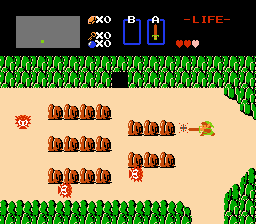
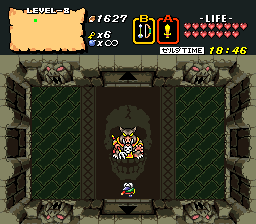
Screenshot of gameplay, showing Link defeating an Octorok with his Sword
Although rather basic by today's standards and in comparison to most later installments of the franchise, the gameplay of the original The Legend of Zelda introduced a revolutionary level of gaming for its time that has since become standard for The Legend of Zelda series as a whole (and other games inspired by it). Many of its innovations include freely exploring a vast overworld, distinctive music, the ability to use multiple different inventoryitems, solving puzzles, fighting enemies or bosses directly in various dungeons, the ability to take damage without fear of immediately dying due to the use of a health meter mechanic, and being able to save the player's progress in a home console (which can be quickly done by pressing Up + A with a second controller on the inventory screen). At the time of release in 1986, The Legend of Zelda was considered one of the most complex action-adventure games and its ruleset was a significant leap compared to the likes of Adventure (which previously was the most popular title of the genre) and the Swordquest series released prior on the Atari 2600, one of the main contributing factors of its great success.
Despite there being no direct confirmation by Nintendo that The Legend of Zelda had taken inspiration by Atari, Inc.'s Adventure (released in 1980), the NES game shares a few elements. Aside from real-time open-world gameplay (although enemies do not chase Link from one area to the next nor actions by them occur off-screen), their settings are based on a medieval fantasy kingdom attacked by an evil sorcerer, having items with prescribed abilities, the protagonist fights dragon-like monsters with a sword (Zelda's case being Aquamentus and Gleeok) and must acquire a sacred object (Enchanted Chalice and Triforce, respectively) to complete the game. Because of these connections, some fans have considered this title as Adventure's "spiritual successor".
Dungeon Exploration
Barring Link's progress are Creatures he must battle to locate the entrances to nine underground Dungeons. Each Dungeon is a unique, maze-like collection of rooms connected by doors and secret passages and guarded by monsters different from those found in the overworld. Link must successfully navigate each Dungeon to obtain one of the eight pieces of the Triforce of Wisdom. Dungeons also conceal useful items, such as a Boomerang for retrieving items and stunning enemies and a Flute with magical properties. The first six Dungeons have visible entrances, but the remaining three are hidden. Except for the final Dungeon - Death Mountain, which can't be entered until the previous eight have been completed, the order of completing Dungeons is somewhat arbitrary, but many Dungeons can only be reached or completed using items gained in the previous one.
Overworld Exploration
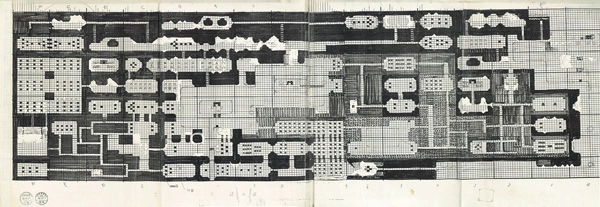
Concept artwork of the game's overworld
Non-linearity, the ability to take different paths to complete the game, separated The Legend of Zelda from its contemporaries (although it is not the first game ever to have this type of exploration), and introduces such a concept for the main series. Link can freely wander the Overworld, finding and buying items at any point, and enabling the flexibility to play the game in unusual ways; for example, it is possible to reach the Final Boss of The Legend of Zelda - Ganon, without actually taking a Sword (but cannot be defeated, however). Nintendo of America's management initially feared that players might become frustrated with the new concept, left wondering what to do next. As a result, the American version of the game's instruction manual contains many hints, tips, and suggestions for players.
After completing the game, the player has access to a more difficult quest, officially referred to as the Second Quest, where Dungeons and the placement of items are different, with stronger enemies. Although a more difficult "replay" wasn't actually unique to The Legend of Zelda, as earlier media already used this concept including Nintendo's own Super Mario Bros., few games offered a "second quest" with entirely different levels to complete. Interestingly, entering "ZELDA" as the player's name starts the Second Quest immediately, making it one of the first Nintendo games to have a hidden code.[24] The Second Quest can be replayed each time it is completed.
Game Information
Development
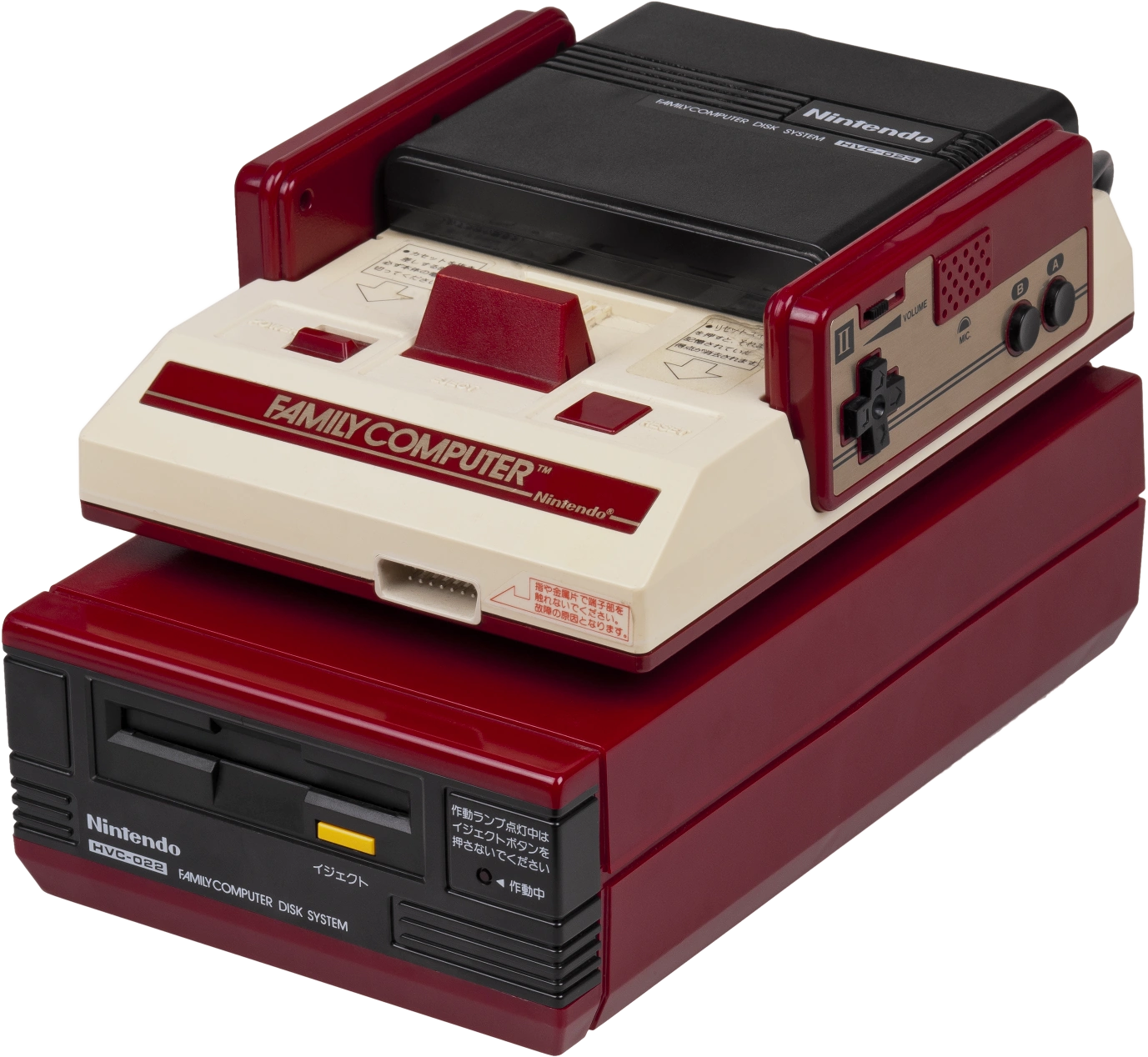
Shortly before starting the concurrent development of Super Mario Bros. for the Mario franchise in 1984, Shigeru Miyamoto began developing The Legend of Zelda as a launch title for the Family Computer Disk System, an add-on for the Famicom using floppy disk media for storing games rather than cartridges.[25] Miyamoto got inspiration for an adventure game from his own explorations to the countryside and hillsides around his home.[26] Seeking to create a fairytale setting, co-developer Takashi Tezuka drew inspiration from J. R. R. Tolkien'sThe Lords of the Rings novel trilogy when writing the story.[27] With the medieval sword and sorcery theme set, Miyamoto wanted to have treasure hunting gameplay to also bring in the sense of adventure seen in movies such as Indiana Jones.[28] The game began as a two-player dungeon creator, but later became a one-player game with underground dungeons that surrounded Death Mountain, with forests, lakes, and Hyrule Field added eventually as they wanted to explore above ground too. Miyamoto wanted to call the game "The Legend of something", so a PR planner suggested "Zelda", the name of F. Scott Fitzgerald's wife, for not only the title and eventual highly successful franchise, but also the eponymous princess character.[29]
Japanese Version
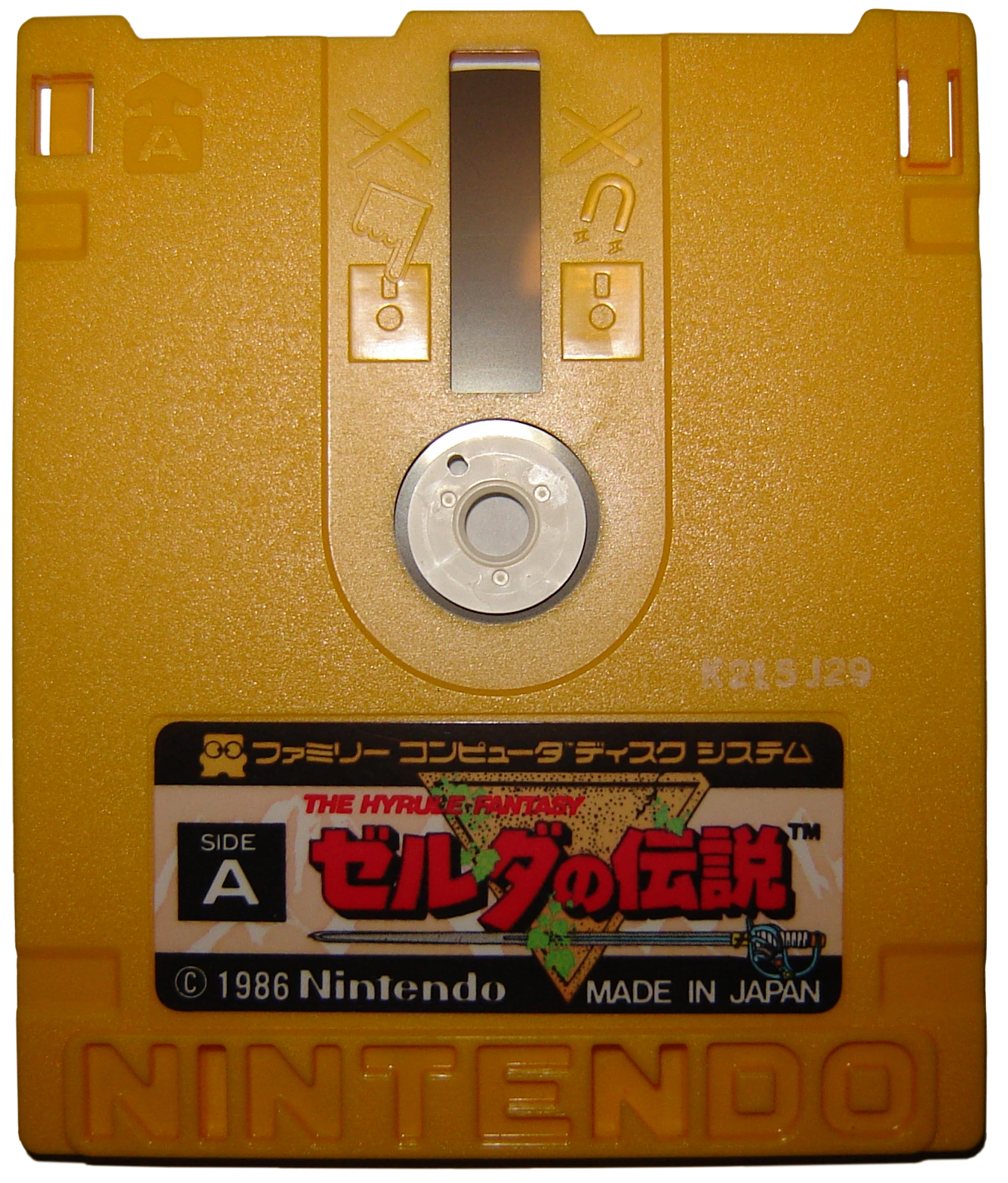
The Legend of Zelda made its debut in Japan as a Family Computer Disk System title rather than the main console
The Legend of Zelda was originally released in 1986 as a launch title for the Famicom Disk System in Japan as Zelda no Densetsu - The Hyrule Fantasy, alongside Super Mario Bros. The Lost Levels (known as Super Mario Bros. 2 in that region) for the Mario series. Apart from facilitating data saving, the disk drive also added an extra wavetable sound channel on top of the Famicom/NES' original five. This has caused the original release to sport quite a different yet unique sound compared to the more widespread Nintendo Entertainment System cartridge release and was considered revolutionary for the time. This difference is most notable during the title screen. As the game's sequel, The Adventure of Link, was also originally released on the FDS, this is also the case as well. In 1994, the game was re-released in Japan under the standard Famicom cartridge format under the name Zelda no Densetsu 1 (despite its copyright year saying 1992). Therefore, this version does not have the exclusive sound effects heard in its initial Disk System counterpart. Interestingly, because The Legend of Zelda was first released in this format, some official artwork exists of Link holding or standing on top of the game floppy disk. Noticeably, in the FDS release, the font for the game's HUD is in a different, thinner lettering compared to the international version.
The Book of Magic item is known as the Bible in the Japanese version of the game. This was likely changed because, at the time, it violated Nintendo of America's very strict content guidelines which disapproved of any real-world religious content or references inside games released for their systems. Strangely enough, all depictions of the Christian cross were kept intact.
The Pols Voice enemy, which is known to hate loud noises, was specifically designed for the microphone on the second controller of the Famicom, where it will die instanty upon detecting any sound (though can still be slain by the Sword, otherwise). In the international version, however, because the NES lacks such a unique feature, players must resort to Arrows to quickly defeat them, Ironically, these items are ineffective against Pols Voices in the initial release.
The original Japanese release uses floppy disks for the Famicom Disk System
The Japanese Famicom Disk System version was included in a promotional package of Charumera-brand ramen, and was only given out as a prize for a contest (only 1,500 copies were made). It is unknown what differences this version has compared to the original release, as the only available existing copies in the region are extremely rare and incredibly expensive.[30] Another major issue is floppy disks are known to be fragile and tend to become damaged from age and/or usage more easily than ROM cartridges, rendering them unplayable. In fact, the disks themselves lack a shutter to reduce costs and the device has a poor quality disk drive along with other problems such as slow loading times, earning criticism and causing the add-on machine to become discontinued as early as 1993. In spite of this, Nintendo kept supporting it for repairs until 2007, alongside the Famicom/NES itself (and later cartridge-based consoles).
Graphics and Audio
Being a game originally designed for storage on a floppy disk, the game's graphics do not use too many elements; sprites are given different color palettes depending on their location in the overworld. For example, trees can be colored either green or orange; brick walls in dungeons are painted blue, green, yellow or white, and so on.
The game features three background themes: the overworld tune, the standard dungeon tune and the final dungeon tune. The first theme has become the franchise's main theme, and it is reused in most later games in the series. The normal dungeon theme is reused as the theme for the Royal Crypt in The Minish Cap and in the Color Dungeon in Link's Awakening DX. Sound samples, such as the one when Link collects a new item and the one when a new path is open, are also often reused in later The Legend of Zelda games.
Regional sound differences
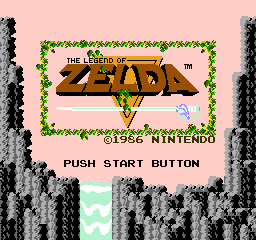
The original Japanese Famicom Disk System version of the game utilizes the disk system's additional frequency-modulation synthesis chip; the title/credits music and certain sound effects are more advanced than the international Nintendo Entertainment System release as a result. Below are some examples of the latter.
With this game being the first ever in the long-ongoing franchise, it is the first time Hyrule is portrayed, and it is divided into numerous parts and landscapes, such as the Lost Woods, Death Mountain, a central lake, a forest, a graveyard, and a shore; as Link walks through them, he manages to find the hidden labyrinths where the fragments of the Triforce are kept. It is unknown whether or not the nameless regions reappeared in later games with official names.
Unlike most Overworlds in The Legend of Zelda series, this incarnation of Hyrule, known as Lesser Hyrule, is completely explorable from the beginning, meaning that Link can go to almost any corner and space of it, with a total absence of linearity (Breath of the Wild and Tears of the Kingdom closely repeats this game's feature). It should be noted that the overworld remains largely unchanged in the Second Quest, with the only changes being the locations of the labyrinths and of special prizes.
Both this game and its sequel are linked in continuity, since The Legend of Zelda revolves around retrieving two of the major fragments of the Triforce (Power and Wisdom), and Ganon is fought and defeated in order to rescue Princess Zelda; The Adventure of Link revolves around finding the third major fragment in order to revive a different incarnation of Zelda that was comatose for a very long time, and to impede the revival of Ganon himself.
Mistranslations
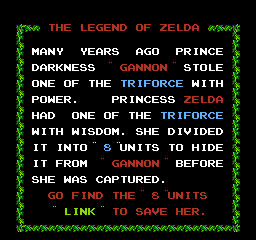
The introduction contains various mistranslations
The Legend of Zelda is littered with mistranslations, direct word-for-word translations, and odd quotes.
The intro story is written poorly, such as stating the Triforce piece Ganon stole is the "Triforce with power", instead of Triforce of Power. For the GBA and Wii Virtual Console ports, the message was entirely rewritten and corrected.
This is the first Zelda game in which Ganon is written as Gannon. This spelling was also used in the Famicom Disk System version of The Adventure of Link[31][32] and in the Super Famicom (Japanese SNES) release of A Link to The Past.[33]
The Old Man is well known for his vagueness in messages. One of his most famous quotations is "DODONGO DISLIKES SMOKE", indicating the Dodongo's weakness to Bombs. Another odd quote is "DIGDOGGER HATES CERTAIN KINDS OF SOUND".
The list of items is titled "all of treasures". The "of" was omitted in subsequent re-releases.
When Link pays the Old Woman behind the waterfall, she will tell him to "Go up, up, the mountaintop." This was corrected to saying, "Go up, up, the mountain ahead". This refers to the path to Level-5.
Credits
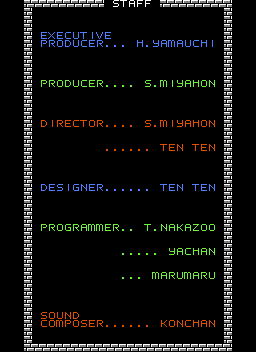
Pseudonyms are used in the credits (Japanese version shown)
In the credits, all but the executive producer Hiroshi Yamauchi are listed under pseudonyms. Designer Takashi Tezuka is credited as "Ten Ten," sound composer Koji Kondo as "Konchan," programmer I. Marui as "Marumaru." At the time, nicknames were commonly used among Japanese game developers as a company measure against employee poaching.[34][35]
Producer and director Shigeru Miyamoto is listed as "S. Miyahon," a mistranscription of his name — 本 can be read as either "moto" or "hon."[35] This is widely believed to be another error in translation. However, in a leaked prototype of the game, many of the staff — including Miyamoto — were credited under their real names.[36] The pseudonym "Miyahon" was thus chosen deliberately for the final release.
The Legend of Zelda was commercially successful, selling a million copies nearly a year after its release,[37] and calculating a total of 6.5 million copies worldwide, making it the sixth best-selling Nintendo Entertainment System game of all time.[38] The Japanese version on the Family Computer Disk System sold approximately 1.75 million of its sales. Until the release of Ocarina of Time which sold 7.6 million worldwide, it was the best-selling title of the Zelda franchise.
Reviews
IGN journalist Craig Harris awarded the Game Boy Advance re-release of the game with an 8.0 out of 10, praising its faithful adaptation from the original version;[39] Damien McFerran from Nintendolife gave the Virtual Console version (Wii) the same score, praising the length and the complexity of the quest.[40] Nintendojo staff, when reviewing the GCN edition (Collector's Edition) praised the game for its "innovative and unique gameplay system, remarkably deep puzzle solving, and an epic score".[41]Nintendo Power, in the December 2009 issue, placed the game third in the list of best The Legend of Zelda games, citing its influence on gaming industry and praising its Gameplay. In 2022, IGN placed it as the "eighth" best Legend of Zelda game in their "Top 10 Best Zelda Games" list countdown; but was then placed as the "ninth" best Zelda game in their new revamped version of their "Top 10 Best Zelda Games" list in 2023.[42][43] In many other sources, due to itself being the game that launched a major franchise, The Legend of Zelda is considered one of the greatest video games ever made.
Fan Reception
The original Zelda game received good support from the player community as well, with most considering it among the best of the NES library. It currently holds an average user score of 9.1 at GameSpot,[44] as well as a current average reader score of 9.1 at IGN.[45] WatchMojo placed it at the #10 spot in their "Top 10 Legend of Zelda Games of All Time" list countdown, and at the #11 spot as part of their "Every Major Legend of Zelda Game Ranked" video over on MojoPlays.[46][47] The Completionist ranked The Legend of Zelda (game) as his tenth best Legend of Zelda game of all time in his "Top 10 Zelda Games" list countdown.[48] Like most other 2D Zelda games, however, some players claim The Legend of Zelda to be rather difficult. WatchMojo also considers it to be the 3rd most difficult entry in the series as part of their "10 HARDEST Zelda Games To Complete" list countdown over on MojoPlays, right behind Breath of the Wild (#2) & Zelda II: The Adventure of Link (#1).[49]
Ports and Remakes
In 1989, Nintendo released a Game & Watch edition of the game simply named Zelda. This particular model of the Game & Watch for this version is in the dual-screen design in what would inspire the Nintendo DS.
BS The Legend of Zelda, the Japan-exclusive SNES edition of the game not seen very often in the world
An extremely rare 16-bit remake of the original game, BS The Legend of Zelda, was broadcast via the BS-X Broadcasting System for the Super Famicom's Satellaview in 1995 and 1997, based on the First and Second Quest, respectively. The gameplay is generally similar to the original, but differs as the game's central heroes are the mascot characters of the BS-X Broadcasting System rather than Link, who are otherwise supposed to be the player itself as the character's name and gender is associated with the broadcasting ID, as well as as altered dungeons and overworld. Aside from the initial green tunic resembling Link's, the male character wears a backwards baseball cap, and the female character has long red hair, similar to Princess Zelda. These particular heroes would appear again in BS The Legend of Zelda: Ancient Stone Tablets (based on A Link to the Past), also broadcasted on the service in 1997. Those exclusive games' time-based gameplay would later inspire that of Majora's Mask.
In 2003, Nintendo released a bundle for the Nintendo GameCube which included the Collector's Edition, in which The Legend of Zelda is playable. This version notably provided a different and more accurate translation of the game script, which was used in most subsequent ports of the game.[50] It also included a few other minor changes, such as reduced screen flashing to prevent seizures, which is followed in the Virtual Console and Switch Online ports.
The original Animal Crossing of the series of the same name, released in 2002, includes a number of emulated NES games as furniture pieces, though some are inaccessible without external assistance. The Legend of Zelda is one such unobtainable game, requiring either a cheating device or having a save file for the game on the memory card of the GameCube.
The Legend of Zelda saw a port on the Game Boy Advance as part of the "Classic NES Series" re-releases in 2004.
Ports of The Legend of Zelda were released on the Virtual Console service for the Wii, Nintendo 3DS, and the Wii U. The Wii Virtual Console port was released in 2006 in most regions, releasing alongside the launch of the service. The 3DS Virtual port was initially available on August 31, 2011, as one of the games eligible for free download as part of the Nintendo 3DS Ambassador Program, a service available to players who bought a 3DS before its price dropped on August 11, 2011.[51] It was later released to the public in 2012 in most regions. The Wii U Virtual Console port was released in 2013. Nearly all Virtual Console ports use the updated changes from the 2003 Collector's Edition version, with the exception of the 3DS Virtual Console port, which instead uses the original game's script.
Super Smash Bros. Brawl features a number of timed, short demos of classic games, called "Masterpieces", in which players may only play up to a certain number of minutes depending on the game. The Legend of Zelda is offered as one of the Masterpieces, and is limited to only two minutes of gameplay time. It returns as part of the Masterpieces library of Super Smash Bros. for Wii U, where the playtime for the demo has been doubled to four minutes.
The NES Classic Edition includes The Legend of Zelda as one of the 30 games available in emulator-based console, alongside The Adventure of Link.
The Nintendo Entertainment System - Nintendo Switch Online software, available to Nintendo Switch Online Subscribers, included The Legend of Zelda as one of its 20 launch titles. Later on during the platform's life, a "special save data" for the game was introduced, titled "The Legend of Zelda™ Living the life of luxury!", that starts the game with more items and Rupees in the players' possession, making the adventure significantly easier.[52] The October 2022 monthly missions included playing The Legend of Zelda (which could be either the main game itself or the special save data version). Although not technically a port of the game itself, September 2022's rewards utilized various NES sprites, including Ganon, a blue moblin, Link, Princess Zelda, and an Old Man from the first Zelda game as part of the rewards for Week 2.
On November 12, 2021, as part of 35th anniversary of The Legend of Zelda franchise, Nintendo released a limited edition Game & Watch: The Legend of Zelda, a device similar in shape and size to the original Game & Watch systems, but with the addition of a D-pad and a color LCD screen. The device contained three ports from the series, TheLegend of Zelda, Zelda II: The Adventure of Link, and the original Game Boy release of The Legend of Zelda: Link's Awakening. The system also included a Zelda-themed version of the Game & Watch game Vermin, where Link replaces Mr. Game & Watch as the playable character, as well as a timer and a clock, based around The Adventure of Link and the first game respectively.[53][54]
Legacy
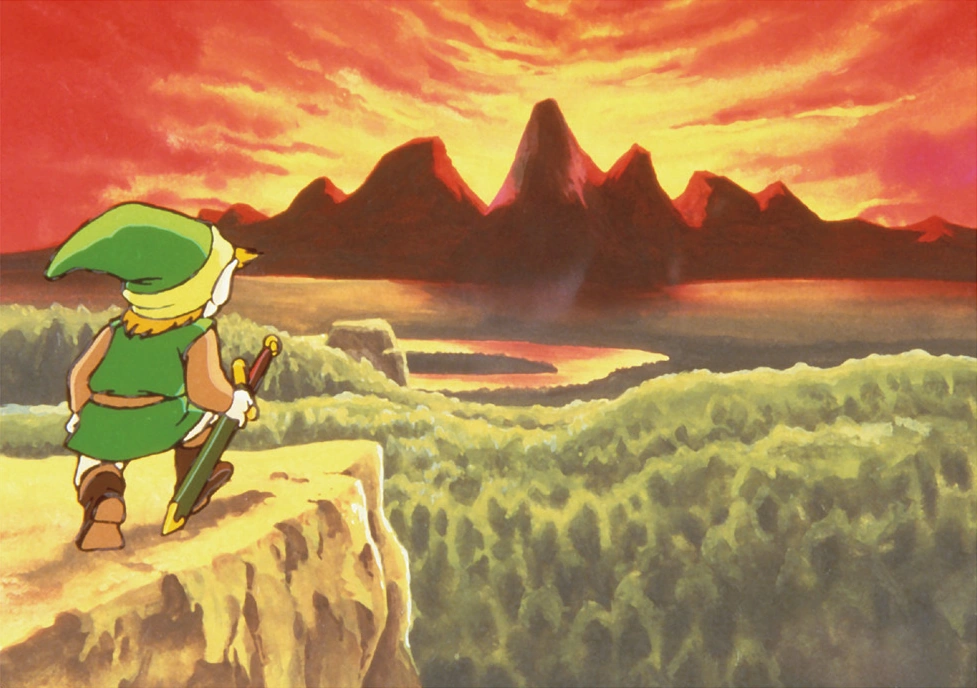
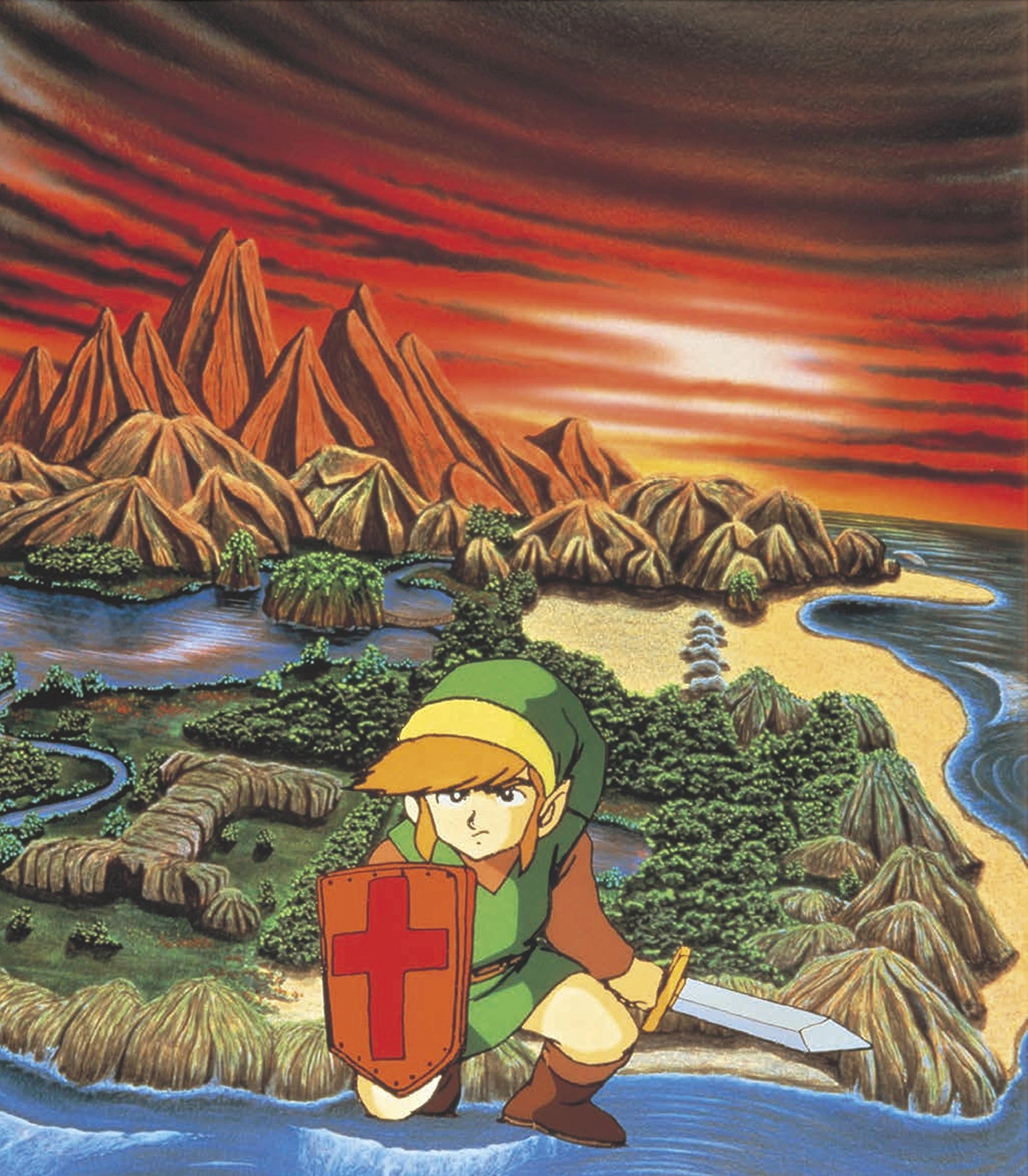
Official artwork used for the Japanese box art of the game
The Legend of Zelda is the very first installment in the Zelda franchise, and its success allowed the development of over 20 sequels in the span of four decades. In one or another way, nearly every title in the series is influenced by this game in such ways as:
The distinction between an overworld and a dungeon, as well as the need to travel across the former to enter the latter, and to clear the latter to take a further step to the game's completion.
The use of items to progress on the adventure, be it to beat enemies more easily or to open new ways and solve puzzles.
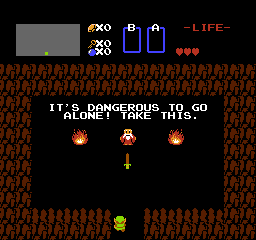
The iconic Old Man quote at the beginning of the game
The original game is known for having certain character lines that had become a popular meme among fans over the years, often due to their vagueness. The Moblin's quote "It's a secret to everybody." is first referenced in A Link to the Past when Link brings a chest to a man who stands next to a sign outside of the desert. He offers to open the chest under the condition that Link will "keep it secret from everyone else". It is also referenced in Ocarina of Time. If Link bribes the guard at the gate of Hyrule Castle, speaking after he opens the gate will result in him saying "KEEP IT A SECRET TO EVERYBODY." And inMajora's Mask, after talking to Kafei in his home behind the Curiosity Shop, he says "Keep what we just talked about a secret from everybody". It is even referenced in Twilight Princess when in Center Castle Town, Link can enter a door and walk up to a balcony, where a Goron sees the golden force around Hyrule Castle. He admits that he has kept it "a secret to everybody." The Moblin's famous quote was not originally planned, however, as during development, it once said "I'll give you this, so leave me alone!".
The Old Man's "It's dangerous to go alone! Take this." also received similar attention as the aforementioned Moblin's respective quote.
Trivia
The Legend of Zelda runs on a heavily modified version of the Super Mario Bros. engine, as both games were developed alongside each other by the same staff. Coincidentally, this would repeat for their 3D equivalents, with Ocarina of Time reusing the engine of Super Mario 64 and also being co-developed.
The plot of the game was originally going to be completely different. At one point in development, The Legend of Zelda was set in the past and future, and Link was supposed to collect electronic chips (which later changed to Triforce Shards). This itself was the original reason for the main protagonist's name according to series creator Shigeru Miyamoto, as he himself was its link. Although this was ultimately scrapped for the final release, Ocarina of Time appears to reuse this concept to an extent, as Link indeed traveled two different time periods in a 7-year gap via the Master Sword.
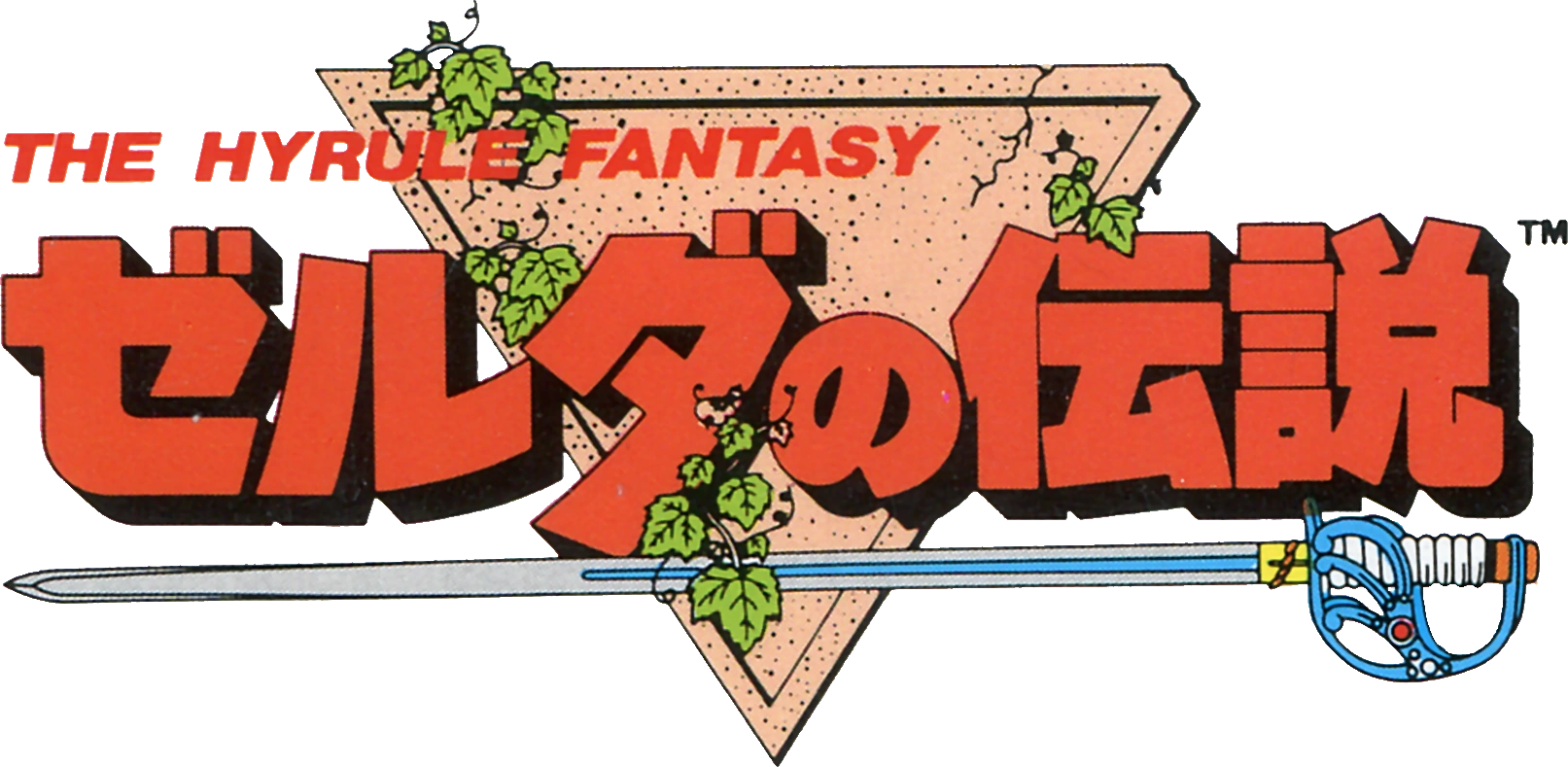
The original Japanese logo of the game, featuring "The Hyrule Fantasy" as the series' originally intended title
Notably, The Hyrule Fantasy was used as the main title for the Japanese version of The Legend of Zelda, with the international release/franchise's name as its subtle. However, this was dropped in all subsequent games for all regions, as adding a third subtitle (such as A Link to the Past/Triforce of the Gods) would have made the overall title too long. This choice was also made to avoid comparisons with Square Enix's similarly titled Final Fantasy series, which said RPG franchise made its debut in 1987.[55]
Although The Legend of Zelda is not the first ever action-adventure game, as Superman or Adventure on Atari 2600 had brought the genre to existence as early as 1979, this title is what first established the rules that what become standard ever since.
Hyrule in The Legend of Zelda may simply be an island. Aside from the kingdom's castle not being present, the artwork used for the Japanese version's box art shows much of the landmass surrounded by water. Indeed, the setting in-game has beaches on the eastern side of the overworld.
During development, a rearrangement of Maurice Ravel's 1928 orchestral song "Boléro" by Koji Kondo was used as the title theme. However, shortly before finishing the game, the developers learned that the song was still under copyright (though it is public domain today). Since they could not delay the release of the Family Computer Disk System and the game itself, Kondo himself wrote the actual title theme in a single night.[56][57]
Although not outright stated by Kondo himself, the 1969 hit rock song "April" from Deep Purple is also widely believed to be an influence for him to compose the main/dungeon themes of The Legend of Zelda due to coincidentally similar music. It also has a slight basis for the Hyrule Castle theme in later games.
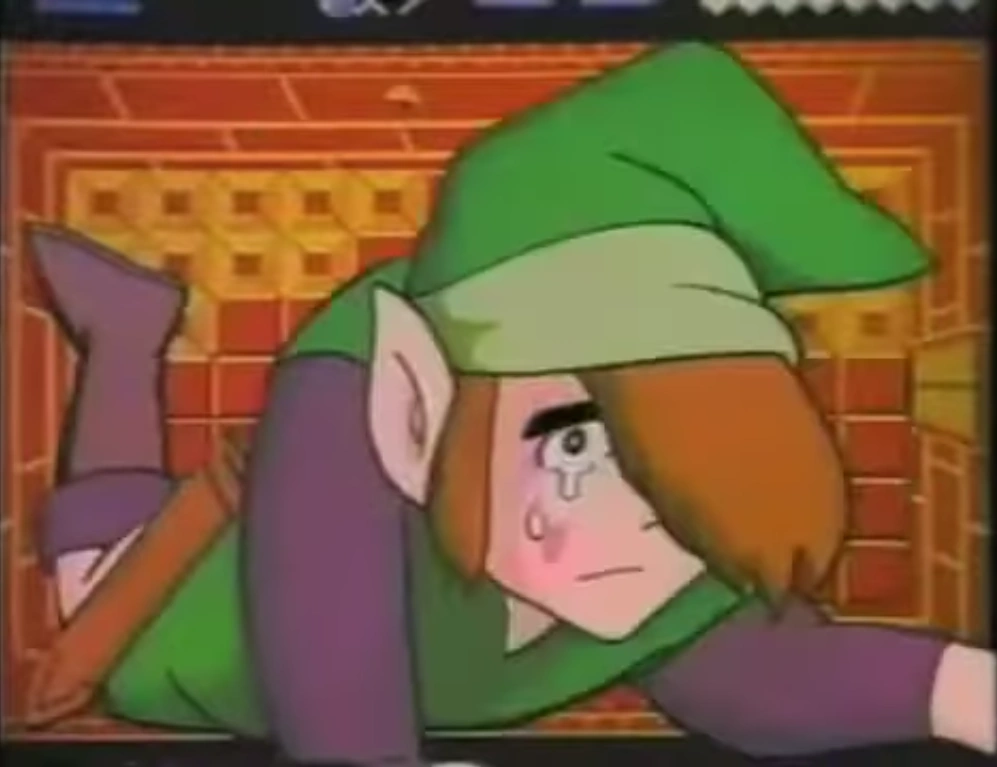
An injured Link seen in the game's Japanese TV commercial
In the original commercial of The Legend of Zelda for the Famicom Disk System in Japan (which also featured Super Mario Bros.: The Lost Levels), an animation of Link can be seen showing himself defeated and his Sword breaking in half as he speaks in frustration to the audience, when the game screen itself played the Game Over animation within Level-6.
Although the Master Sword did not yet exist for the franchise until A Link to the Past, the strongest Sword in the game (as well as its sequel), the Magical Sword, is seen as its precursor.
The second form of Majora, the Nintendo 64 game's Final Boss, Majora's Incarnation, also sings a part of Level-9's theme when it begins spinning around in a dance.
The nine Dungeons of the game during the First Quest are designed to be shaped like a simple object or creature (like an eagle or crescent moon) so the casual gamer can be able to navigate more easily without relying on a strategy guide. However, Level-3 has a certain map that was deemed controversial to the West during its release (although the attention it received was small).
Interestingly, all of the dungeons can fit together in a rectangular grid. This is likely due to memory limitations.
Despite the original The Legend of Zelda in a non-speedrun playthrough can be quickly completed in less than two hours by an experienced player using a guide today, much faster than all later mainline titles of the series (due to storage limitations), because the non-linearity game itself was made in the mid-1980s - long before the widespread era of the Internet and even predates when official strategy guide books became common (its first ever published guide, Nintendo Power #1, was released in 1988), many older players who have bought and played The Legend of Zelda when it was brand new claimed the game highly challenging to complete in one sitting, with some taking a few months or even years, in contrast to Super Mario Bros. and most other NES titles at the time. In fact, with a memory size of 128KB, The Legend of Zelda was considered one of the largest games during its release.
It should be noted that unlike Super Mario Bros. (or most Mario games in general), which is a game for the platformer genre, The Legend of Zelda is the complete opposite in overall gameplay design, as the franchise itself according to Nintendo is specifically made to have players communicate to each other on how to solve tasks and find hidden items or dungeons, which would be a partial inspiration for the Animal Crossing series.
The aftermath of the final battle in this title remains the only case where Link completely takes away Ganon's Triforce of Power
This game is the first and so far only instance anywhere in the franchise where the Triforce of Power was actually taken away from Ganon by Link and the latter obtains this piece of the Triforce by itself after he destroys the main antagonist with a Silver Arrow, despite this occurring at the very end of the quest.
In the beta version of the game, the Old Man at the very beginning was originally going to make Link choose between having the Sword or the Boomerang as his first weapon.
Bosses can be heard periodically roaring as Link is at or near their location within dungeons. In the Japanese version, notably, they're at first rather quiet before going into full volume when they begin attacking the young hero.
Breath of the Wild, released over three decades later in 2017, marks a long-awaited return of the non-linear open world exploration gameplay from this game.
Fire Bars, a recurring obstacle from the Mario series, were originally supposed to make their debut in this game. However, the development team instead transferred them to Super Mario Bros. as they found it more suitable for that franchise's platforming gameplay, according to Takashi Tezuka. Nevertheless, Fire Bars do make a few appearances in Zelda since A Link to the Past alongside the Chain Chomp - another concept initially meant for the latter series.
In 2012, an all-yellow prototype NES cartridge of the game was sold on Ebay for the price of $55,000, breaking previous records.
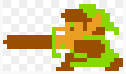
Link's attack sprite
In spite of Link himself being widely known as a powerful swordsman, due to the hardware limitations of the game, he can only perform a simple forward thrust with his Sword as he attacks enemies. Therefore, he does not swing the blade nor special techniques exist in the original The Legend of Zelda, unlike all subsequent installments.
Interestingly, if the Second Quest is completed, the ending credits will display "End of The Legend of Zelda 1", even in the Japanese version. It is possible the game was anticipated by the developers to be a massive success or The Adventure of Link was already in development by The Legend of Zelda's release.
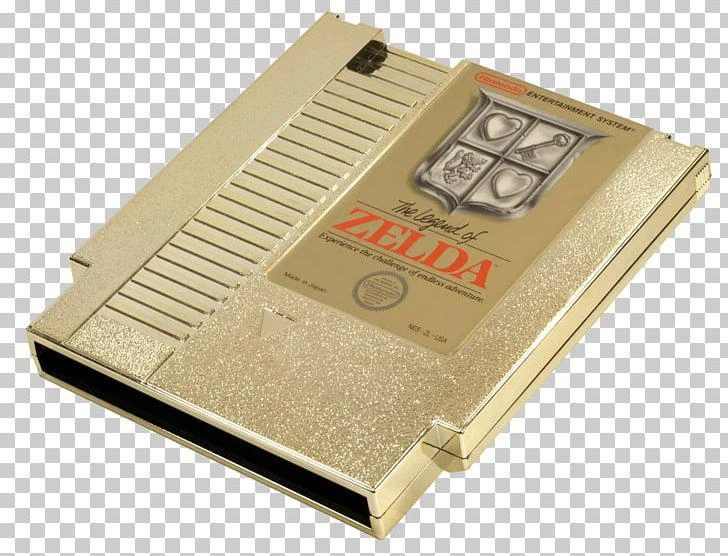
The international NES release is famous for being in unique golden cartridges
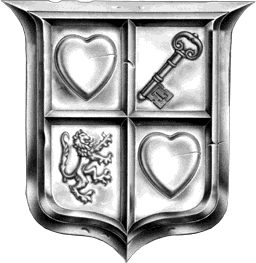
The cartridges of The Legend of Zelda, rather than the standard gray, are in a unique shiny gold, making itself popular among collectors. However, the late-release Classic Series version of the game in 1994 came in the traditional color.[58] This packaging concept was reused for The Adventure of Link as well. Unlike the vast majority of other NES games, the original box package of both Zelda games uniquely have a portion of it cut out to reveal the golden cartridge inside, specifically at the top-left part of the shield on the artwork in case of the former. The game cartridge being gold is likely a reference to the Triforce, which itself within the franchise is known to be golden.
Although this game and its sequel are the most well-known examples of the NES library to be in gold cartridges, a few others exist, most prominently the extremely rare Nintendo World Championship titles starting in 1990.
The pre-release order of Ocarina of Time and all international versions of Majora's Mask would also be in gold colored cartridges, although their textures are matte and the plastic casting are known to be more brittle than traditional N64 copies.
Official merchandise exists of a coffee mug based on the game cartridge, with a square shape.
The game depicts the Triforce of Power upside-down and is even used for the title logo and credits. An inverted Triforce would not be seen in the mainline series until A Link Between Worlds, 27 years later in 2013, for the Lourle counterpart.
In early versions of the game, the Triforce was called "Power Triangle".
The 1987 international NES release of the game marks the first time cartridges used save batteries to store in-game files. This was a novelty at the time, as most early video games well into the 1990s used passwords instead or have no way of remembering the player's progress at all.
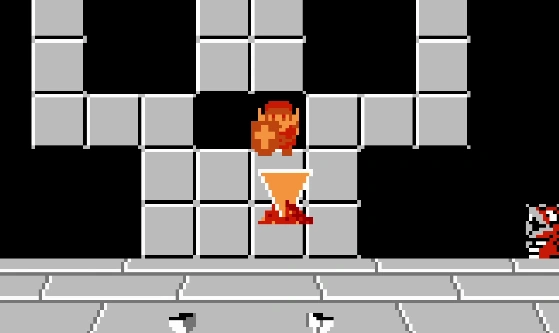
An artwork of Link opening Treasure Chests for this title exists. However, they do not appear in-game, as the hero can only find exposed key items in the basement of Dungeons always containing four Keese. This suggests they were initially intended to debut in The Legend of Zelda rather than A Link to the Past, but were unable to due to memory limitations.
Namco's challenging 1984 role-playing maze arcade game The Tower of Druaga is seen as an influence for The Legend of Zelda.
The Legend of Zelda's original Japanese release date - February 21st, is only six days before the release of its region's PokémonRed/Blue (Pocket MonstersRed/Green) of the Pokémon series, on the 27th of the same month. In fact, the two Nintendo flagship franchises themselves made their debuts almost exactly ten years apart, as the latter for the Game Boy was released in 1996.
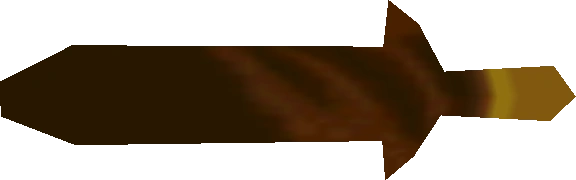
The early Kokiri Sword from the N64 games, which is similar to the basic Sword from this title
The beta version of the Kokiri Sword during development in Ocarina of Time has a strong resemblance to the starting Sword of The Legend of Zelda.
↑"First, we started making The Legend of Zelda, and then we started Super Mario Bros. The Legend of Zelda was for the Family Computer Disk System, so we decided to finish up Super Mario Bros. first." —Shigeru Miyamoto (The Legend of Zelda Developer Interview)
↑"When I was younger, I grew up in the countryside of Japan. And what that meant was I spent a lot of my time playing in the rice paddies and exploring the hillsides and having fun outdoors. When I got into the upper elementary school ages — that was when I really got into hiking and mountain climbing. There's a place near Kobe where there's a mountain, and you climb the mountain, and there's a big lake near the top of it. We had gone on this hiking trip and climbed up the mountain, and I was so amazed — it was the first time I had ever experienced hiking up this mountain and seeing this big lake at the top. And I drew on that inspiration when we were working on the Legend of Zelda game and we were creating this grand outdoor adventure where you go through these narrowed confined spaces and come upon this great lake. And so it was around that time that I really began to start drawing on my experiences as a child and bringing that into game development." —Shigeru Miyamoto (Q&A;: Shigeru Miyamoto On The Origins Of Nintendo's Famous Characters)
↑"The two program designers Shigeru Miyamoto and Takashi Tezuka were responsible for the game, who set themselves the goal of developing a fairytale adventure game with action elements. [...] Takashi Tezuka, a great lover of fantasy novels such as Tolkien's Lord of the Rings, wrote the script for the first two games in the Zelda series." (Club Nintendo vol. 8 no. 2, Nintendo of Europe, April 1996, pg. 72)
↑"The Indiana Jones movies were out around that time. [...] I wanted to bring that sense of adventure to a video game. [...] So with a world of swords and sorcery as my theme, I decided to make an adventure game based on treasure-hunting, and that was the beginning of The Legend of Zelda." —Shigeru Miyamoto (The Legend of Zelda Developer Interview)
↑"A special and very rare version of the game was also released as a promotion for Charumera-brand ramen: [...] Now comes the big question – what about this version of the game is different from the standard version? The answer: nobody seems to know." — Miscellaneous, Legends of Localization, retrieved July 18, 2019.
↑"SEVERAL YEARS AFTER GANNON WAS DESTROYED,LINK LEARNS FROM IMPA ABOUT THE ANOTHER SLEEPING PRINCESS ZELDA." — N/A (The Adventure of Link, Japanese Version)
↑ 35.035.1"In early U.S. releases of a few Mario games, he was sometimes credited as "Miyahon", a mistranscription of the kanji in his name (本 — which can be read as either hon or moto). The misread surname was Miyamoto's development nickname in the 1980s (having a nickname was a common practice among Japanese game developers at the time)." — Shigeru Miyamoto biography, Mario Mayhem, retrieved November 15, 2013.
↑"The game was re-released for the GameCube in 2003, the Game Boy Advance in 2004, the Wii Virtual Console in 2007 and the Wii U Virtual Console in 2013. The emulations are all altered with a new translation, in an attempt to reduce the amount of Engrish. This altered version of the game, oddly enough, didn't make the cut when the game was released on the Nintendo 3DS, which instead uses a modified US PRG1." — N.A, The Legend of Zelda/Console Differences - The Cutting Room Floor, The Cutting Room Floor, published N.A, retrieved July 28, 2018.
↑"Perhaps more interesting than the addition of three additional NES games is an unexpected release of “special save data” for The Legend of Zelda, a game that was part of the Nintendo Entertainment System – Nintendo Switch Online launch lineup. That save data will let players “start their adventure with a ton of rupees and items, including the White Sword, Magical Shield, Blue Ring and Power Bracelet.” Basically, that save file will make The Legend of Zelda a much easier game to start playing for newcomers.
In a press release, Nintendo promised to release more special save data for other NES titles, “offering fun new entry points into fan-favorite games.”" — Michael McWhertor, Nintendo adds more NES games to Switch Online lineup, Polygon.
↑"The Legend of Zelda: A Link to the Past, which was for the Super NES, already had a subtitle, so maybe we thought that tacking on "The Hyrule Fantasy" would make the title too long. [...] It's a bit like Final Fantasy! That may indeed have been another reason. We might've looked like copycats!" —Shigeru Miyamoto (The Legend of Zelda Developer Interview)
↑"For quite a while, it just played Ravel's Bolero. It really matched the opening crawl! [...] But immediately before finishing The Legend of Zelda, we learned it was still under copyright. [...] So I pulled an all-nighter to compose the opening song." —Koji Kondo (The Legend of Zelda Developer Interview)
↑"In Japan, music usually enters the public domain 50 years after the death of the composer. [...] And Ravel, who wrote the music we were using for the opening crawl, lived a long time ago, so we thought we were safe. But we looked it up just to be safe and found out it had been something like 49 years and 11 months since Ravel's passing and the copyright would run out in a month. [...] And we couldn't delay the release of the Family Computer Disk System." —Shigeru Miyamoto (The Legend of Zelda Developer Interview)
↑"NES Gray Cartridge This was basically the same version as the gold cartridge (at least to my knowledge) and was re-released as part of the "Classic Series" around 1994 or so." — Miscellaneous, Legends of Localization, retrieved July 18, 2019.







ending.gif)


